
Enterprise Data Lakehouse for Retail & CPG
Executive Summary & Challenges
Modern retail and consumer goods organizations often struggle to scale AI-driven personalization and maintain efficient supply chains due to fragmented legacy systems. Before adopting a unified architecture, companies typically face several critical bottlenecks:
Data Silos:Customer data lives in CRM systems, transactional data in relational databases, and clickstream data in disparate cloud storage, preventing a unified "Customer 360" view.
Stale Insights:Traditional data warehouses struggle to process high-velocity e-commerce clickstream and point-of-sale (POS) data, leading to delayed reporting.
Inefficient AI/ML:Data scientists spend 80% of their time on data engineering and pipeline maintenance rather than building and deploying predictive models.
Supply Chain Volatility:The inability to accurately forecast demand leads to overstocking of slow-moving items and stockouts of trending products.
Core Platform Capabilities
The solution leverages the Databricks platform to build a governed, scalable architecture:
Delta Lake:Provides ACID transactions and scalable metadata handling. It ensures reliable streaming and batch data processing for inventory updates and order fulfillment.
Unity Catalog:Delivers unified governance and security across all data, analytics, and AI assets. This ensures compliance with data privacy regulations (GDPR, CCPA) by managing fine-grained access controls.
Databricks SQL:Empowers business analysts and merchandisers to run high-performance ad-hoc queries and build dashboards directly on the data lake without moving data.
MLflow:Manages the complete machine learning lifecycle, from tracking experiments for demand forecasting models to deploying real-time recommendation engines.
Databricks Mosaic AI:Enables the fine-tuning of large language models (LLMs) to power generative AI customer service chatbots and automated product description generation.
Strategic Use Cases
Real-Time Customer 360 & Personalization
Mechanism: Ingests web clickstream data (via Apache Kafka) and merges it with historical purchase data in real-time.
Action: Powers the real-time recommendation engine; if a user abandons a cart, the system instantly triggers personalized emails with dynamic pricing incentives.
Demand Forecasting & Inventory Optimization
Mechanism: Machine learning models ingest historical sales data, promotional calendars, weather forecasts, and social media trends to predict product demand at the SKU level.
Action: Automatically adjusts reorder points and dynamically allocates inventory across regional fulfillment centers to minimize delivery times.
Dynamic Pricing
Mechanism: Continuously processes competitor pricing data, current inventory levels, and consumer demand elasticity.
Action: Algorithms automatically adjust pricing on the e-commerce storefront to maximize margins or clear out aging inventory.
Generative AI for Customer Support
Mechanism: Uses enterprise-specific data (product manuals, return policies, customer history) grounded via Retrieval-Augmented Generation (RAG).
Action: Powers an intelligent virtual assistant capable of handling complex customer queries and assists merchandisers in drafting SEO-optimized product copy.
Reference Architecture
The platform follows a Medallion Data Pipeline to transform raw, fragmented retail data into high-value insights.
Databricks Lakehouse for Retail, CPG & E-Commerce reference Architecture
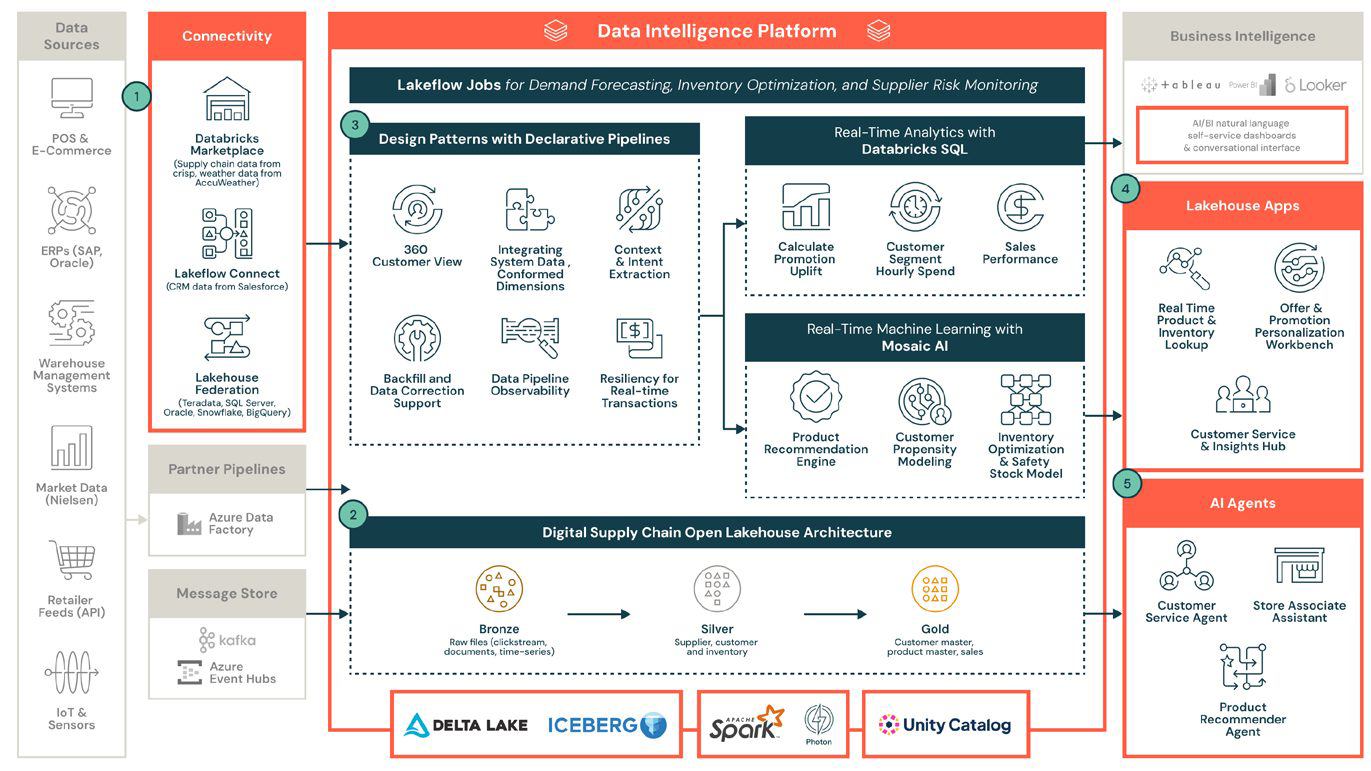
Architectural Component Breakdown
Ingestion:
Real-time streaming (IoT devices in warehouses, website clickstreams) and batch ingestion (ERP systems, ad network APIs) flow into the platform.
Storage (Delta Lake):
Bronze: Raw, immutable data history.
Silver: Cleaned, filtered, and augmented data (e.g., unified customer IDs).
Gold: Business-level aggregates ready for BI (e.g., daily sales by region, customer churn risk scores).
Serving & Consumption:
BI & Analytics: Power BI / Tableau connected via Databricks SQL endpoints.
Machine Learning: Model serving endpoints hit by the e-commerce backend for real-time recommendations.
Measurable Business Impact
Organizations adopting this unified lakehouse architecture typically achieve significant operational improvements:
- 30% Reduction
- in overall data infrastructure costs by migrating from legacy data warehouses to a unified Lakehouse.
- 4x Faster
- time-to-insight for daily merchandising reports.
- 20% Decrease
- in supply chain waste due to highly accurate ML-driven demand forecasting.
- 15% Increase
- in customer retention through hyper-personalized marketing campaigns.